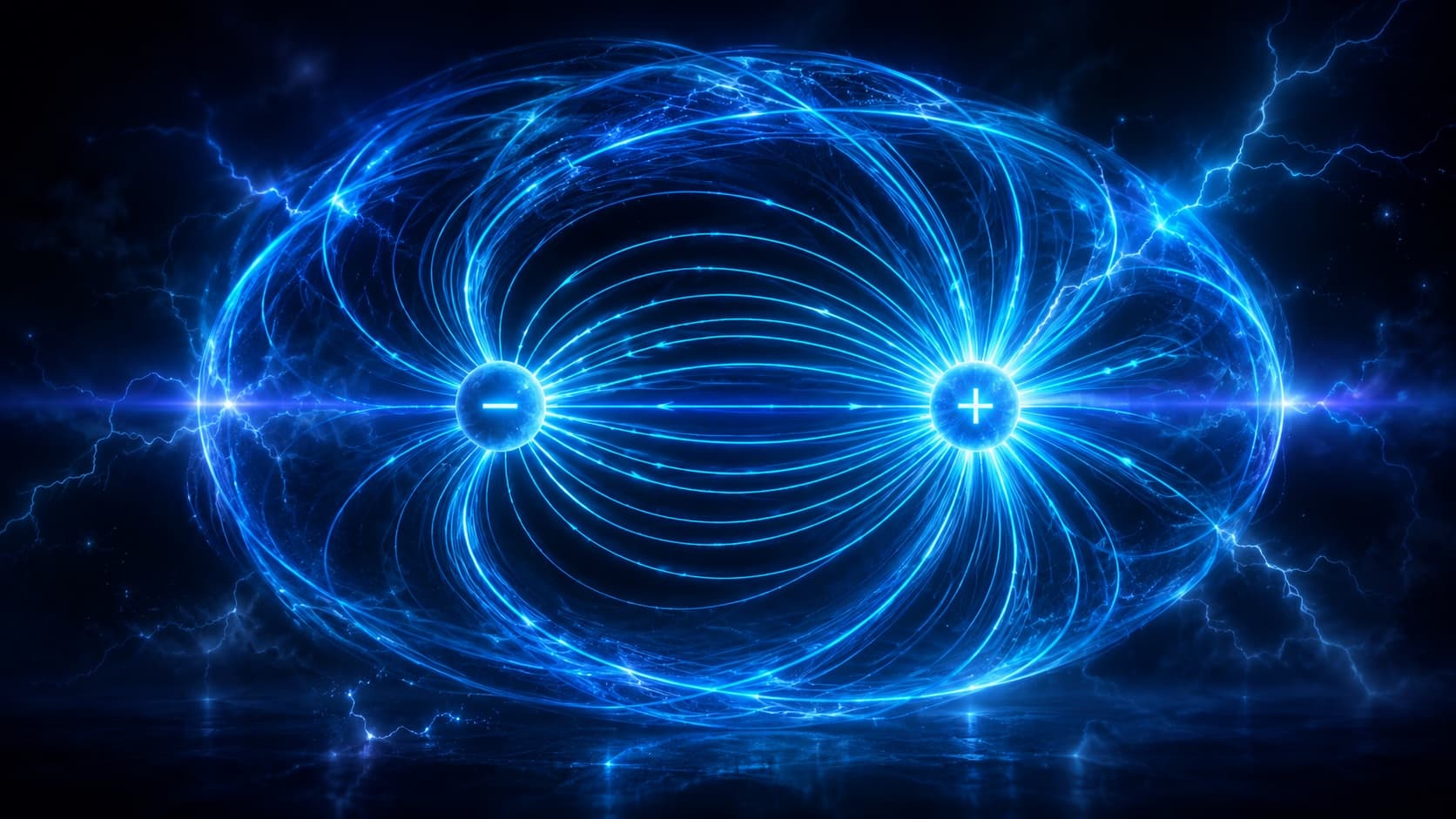
The four Maxwell equations unified
PHYS 301 · Maxwell's Equations
Maxwell's equations summarize classical electromagnetism. This lesson presents the four equations in integral form and explains their physical meanings.
Key equations
\oint \vec{E}\cdot d\vec{A}=\frac{Q_{enc}}{\epsilon_0}\oint \vec{B}\cdot d\vec{A}=0\oint \vec{E}\cdot d\vec{\ell}=-\frac{d\Phi_B}{dt}\oint \vec{B}\cdot d\vec{\ell}=\mu_0 I_{enc}+\mu_0\epsilon_0\frac{d\Phi_E}{dt}I_d=\epsilon_0\frac{d\Phi_E}{dt}\nabla\cdot\vec{E}=\frac{\rho}{\epsilon_0}\nabla\cdot\vec{B}=0\nabla\times\vec{E}=-\frac{\partial\vec{B}}{\partial t}\nabla\times\vec{B}=\mu_0\vec{J}+\mu_0\epsilon_0\frac{\partial\vec{E}}{\partial t}Learning objectives
- State Maxwell's equations in integral form.
- Explain the physical meaning of each equation.
- Describe Maxwell's displacement current term.
- Connect integral and differential forms conceptually.
- Explain how Maxwell's equations unify earlier laws.
The unification of electromagnetism
Maxwell's equations are the foundation of classical electromagnetism. They describe how electric and magnetic fields are produced by charges, currents, and changing fields. Together with the Lorentz force law, they explain electrostatics, circuits, magnetism, induction, electromagnetic waves, and light.
The equations can be written in integral or differential form. This lesson focuses on integral form because it connects directly to flux, circulation, charge, and current.
Gauss's law for electricity
The first equation is Gauss's law:
oint ec{E}cdot d ec{A}= rac{Q_{enc}}{epsilon_0}
It says electric flux through a closed surface equals enclosed charge divided by . Electric charges are sources and sinks of electric fields. Positive charge produces net outward flux; negative charge produces net inward flux.
This equation generalizes Coulomb's law and remains true for time-dependent fields.
Gauss's law for magnetism
The second equation is
oint ec{B}cdot d ec{A}=0
It says the net magnetic flux through any closed surface is zero. There are no isolated magnetic monopoles in classical electromagnetism as normally observed. Magnetic field lines do not begin or end; they form closed loops.
A bar magnet has north and south poles, but cutting it in half produces two smaller magnets, each with both poles.
Faraday's law
The third equation is Faraday's law:
oint ec{E}cdot d ec{ell}=- rac{dPhi_B}{dt}
It says a changing magnetic flux induces a circulating electric field. This is the principle behind generators, transformers, and inductors.
The electric field in Faraday's law is not purely electrostatic. Its closed-loop integral can be nonzero, meaning it cannot be described only by a scalar potential.
Maxwell-Ampère law
The fourth equation is the Maxwell-Ampère law:
oint ec{B}cdot d ec{ell}=mu_0 I_{enc}+mu_0epsilon_0 rac{dPhi_E}{dt}
The first term is Ampère's law: currents create circulating magnetic fields. The second term is Maxwell's displacement current term: changing electric flux also creates magnetic fields.
This addition was essential for consistency with charge conservation and for predicting electromagnetic waves.
Displacement current
In a charging capacitor, conduction current flows in the wires, but no charge crosses the gap between plates. Yet a magnetic field exists around the region. Maxwell recognized that the changing electric field between the plates plays the role of an effective current:
I_d=epsilon_0 rac{dPhi_E}{dt}
This displacement current is not ordinary charge flow through the gap, but it produces magnetic fields.
Local differential forms
In differential form, Maxwell's equations are
ablacdot ec{E}= rac{ ho}{epsilon_0}$$ablacdot ec{B}=0$$
abla imes ec{E}=- rac{partial ec{B}}{partial t}$$abla imes ec{B}=mu_0 ec{J}+mu_0epsilon_0 rac{partial ec{E}}{partial t}$$
These express local relationships at each point in space.
The big idea
Maxwell's equations unify electric and magnetic fields. Charge creates electric flux, magnetic monopoles are absent, changing magnetic fields create circulating electric fields, and currents plus changing electric fields create circulating magnetic fields. Their unity predicts electromagnetic waves and identifies light as an electromagnetic phenomenon.
Sign in to track your progress.
Ask your AI physics guide
Ask anything about Electricity and Magnetism — The four Maxwell equations unified, or choose a suggested question below.
AI responses are educational and may not be perfectly accurate. Press Enter to send, Shift+Enter for new line.