How lasers work
PHYS 310 · Modern Optics
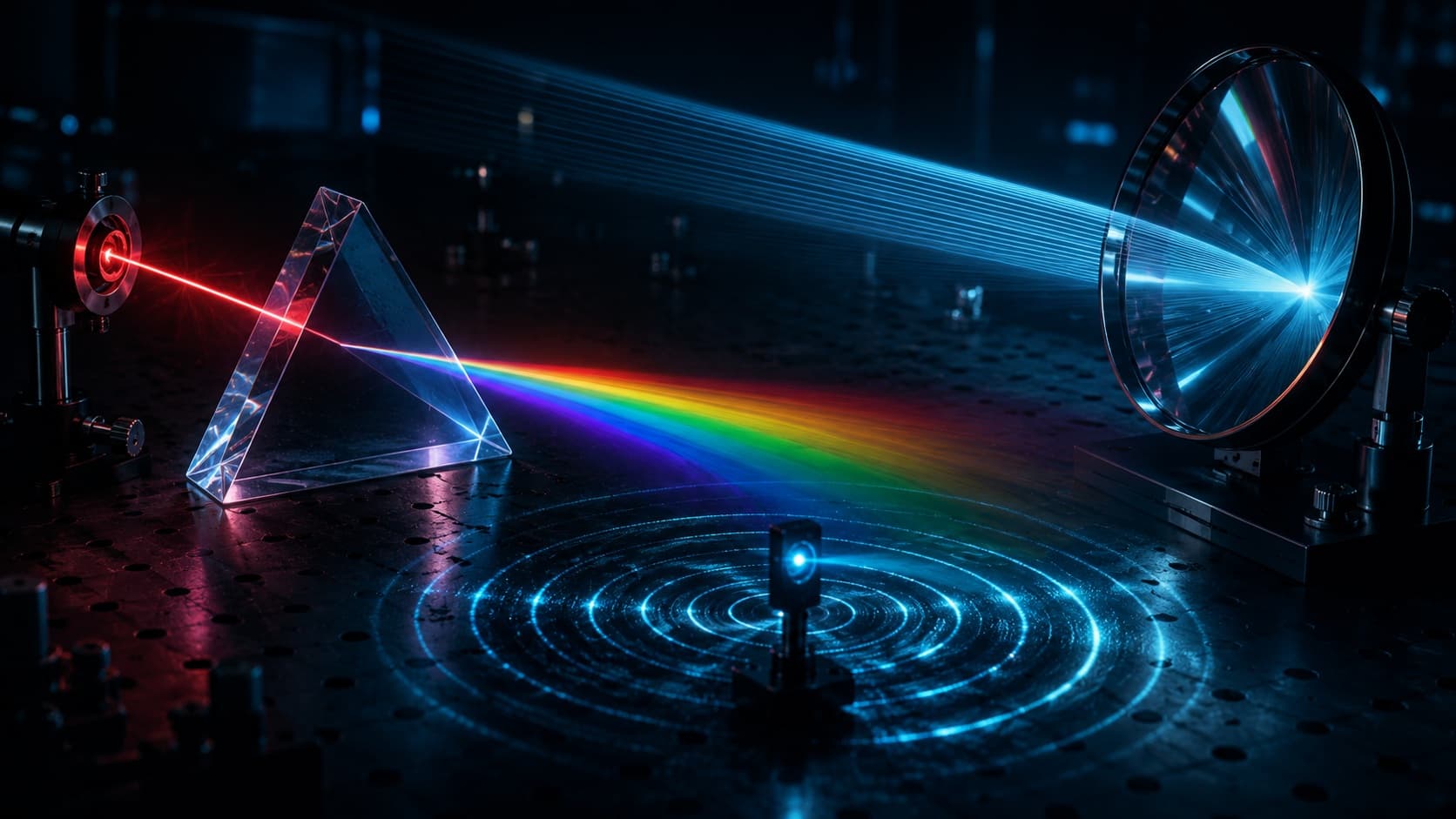
Lasers produce coherent, directional, nearly monochromatic light through stimulated emission and optical feedback. This lesson explains energy levels, population inversion, and laser cavities.
Key equations
E=hfhf=E_2-E_1L=m\frac{\lambda}{2}Learning objectives
- Explain the meaning of laser.
- Distinguish absorption, spontaneous emission, and stimulated emission.
- Define population inversion.
- Describe the role of an optical cavity.
- Explain why laser light is coherent and directional.
What laser means
LASER stands for light amplification by stimulated emission of radiation. A laser produces light that is usually highly directional, nearly monochromatic, and highly coherent compared with ordinary light.
These properties make lasers useful for measurement, communication, surgery, manufacturing, scanning, spectroscopy, and research.
Absorption and emission
Atoms and molecules have quantized energy levels. A photon of energy
can be absorbed if its energy matches the difference between two levels:
An excited atom can return to a lower energy state by emitting a photon.
There are two kinds of emission: spontaneous and stimulated. In spontaneous emission, an excited atom emits a photon randomly. In stimulated emission, an incoming photon causes an excited atom to emit a second photon with the same frequency, phase, direction, and polarization.
Stimulated emission
Stimulated emission is the key laser process. The emitted photon is coherent with the stimulating photon. This means the light is amplified without destroying phase relationships.
If many excited atoms are available, one photon can stimulate many more, producing optical gain.
Population inversion
Under normal thermal equilibrium, lower energy states are more populated than higher states. To get laser amplification, more atoms must be in an excited state than in a lower state involved in the transition. This condition is called population inversion.
Population inversion is not an equilibrium state. It requires pumping energy into the laser medium using light, electrical discharge, chemical reactions, or current injection.
Optical cavity
A laser cavity uses mirrors to provide feedback. Light bounces back and forth through the gain medium, stimulating more emission. One mirror is partially transmitting, allowing some light to escape as the laser beam.
Only cavity modes satisfying standing wave conditions are strongly supported. For a cavity of length ,
L=m rac{lambda}{2}
where is an integer.
Threshold
Laser action begins when gain exceeds losses. Losses include mirror transmission, absorption, scattering, diffraction, and imperfect alignment. The threshold condition is when amplification per round trip balances total loss.
Above threshold, coherent light builds up rapidly in the cavity modes.
Laser properties
Laser light is highly directional because the cavity selects waves traveling along its axis. It is nearly monochromatic because atomic transitions and cavity modes select narrow frequency ranges. It is coherent because stimulated emission preserves phase.
Real lasers are not perfectly monochromatic or perfectly coherent. Their linewidth, beam quality, and stability depend on design.
Types of lasers
Common laser types include gas lasers, solid-state lasers, diode lasers, fiber lasers, dye lasers, and free-electron lasers. Diode lasers are compact and common in communications and electronics. Solid-state and fiber lasers are important in industry and medicine.
The big idea
Lasers work by stimulated emission, population inversion, and optical feedback. Pumping creates excited atoms or carriers, stimulated emission amplifies coherent light, and the cavity selects modes and direction. The result is light with exceptional coherence, directionality, and spectral purity.
Sign in to track your progress.
Ask your AI physics guide
Ask anything about Optics and Light — How lasers work, or choose a suggested question below.
AI responses are educational and may not be perfectly accurate. Press Enter to send, Shift+Enter for new line.