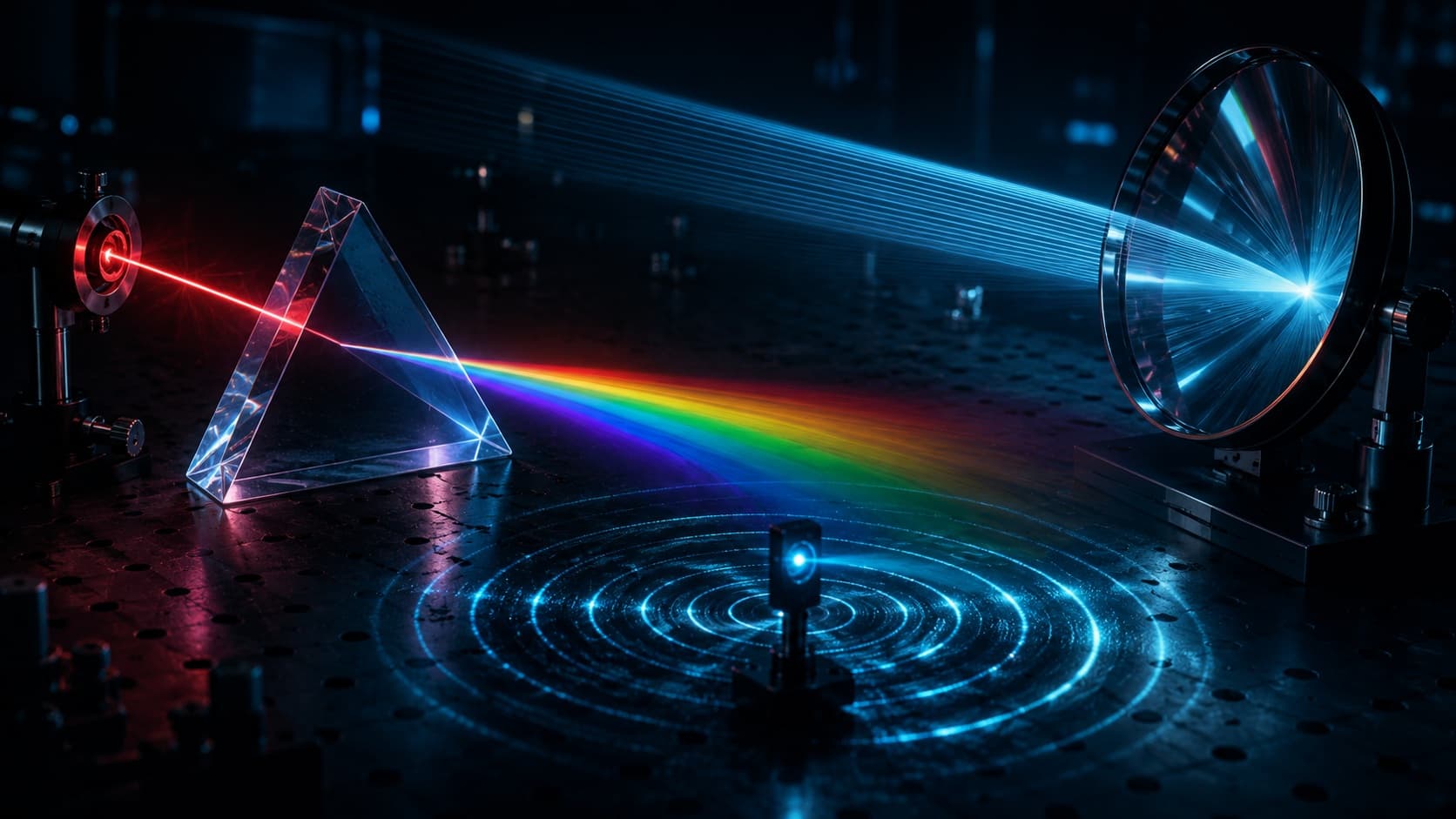
Introduction to quantum optics
PHYS 310 · Modern Optics
Quantum optics studies light at the photon level and its interaction with matter. This lesson introduces photons, single-photon interference, photon statistics, and entanglement conceptually.
Key equations
E=hf=hbaromegap=
rac{h}{lambda}K_{max}=hf-phiLearning objectives
- Describe photons as quanta of light.
- Relate photon energy and momentum to frequency and wavelength.
- Explain the photoelectric effect conceptually.
- Describe single-photon interference and which-path information.
- Introduce photon statistics and entanglement.
Light as wave and quantum
Classical optics treats light as an electromagnetic wave. This explains interference, diffraction, polarization, and many imaging effects. But some phenomena require light to be quantized. Quantum optics studies light as photons and examines how quantum states of light interact with matter.
A photon has energy
and momentum
p= rac{h}{lambda}
These equations connect wave properties to particle-like energy and momentum.
Photoelectric clue
The photoelectric effect showed that light transfers energy in discrete packets. Electrons are emitted from a material only if light frequency exceeds a threshold, regardless of intensity. Increasing intensity increases the number of emitted electrons, but frequency controls their maximum kinetic energy.
Einstein explained this using photons. The basic energy relation is
where is the work function.
Single-photon interference
In a double-slit experiment with extremely weak light, photons can be sent one at a time. Each photon is detected as a localized event, but after many detections an interference pattern appears.
This suggests that quantum probability amplitudes pass through the alternatives and interfere. It is not simply that photons are tiny classical balls going through one slit with ordinary waves guiding them.
Measurement and which-path information
If an experiment determines which slit a photon passes through, the interference pattern disappears. Interference requires indistinguishable alternatives. This is a central idea in quantum mechanics.
The issue is not merely mechanical disturbance. The availability of which-path information changes the quantum description.
Photon statistics
Classical light intensity can vary continuously, but quantum optics studies photon counting statistics. Coherent laser light has photon number fluctuations described approximately by Poisson statistics. Thermal light has different statistics and stronger bunching.
Photon correlation measurements can reveal whether light is classical-like or nonclassical.
Spontaneous and stimulated emission
Quantum optics also explains emission. In spontaneous emission, an excited atom emits a photon into an available mode. In stimulated emission, an incoming photon enhances emission into the same mode. Lasers rely on stimulated emission, but a quantum treatment explains noise, linewidth, and photon statistics more deeply.
Entanglement
Photons can be produced in entangled states, where measurements on one photon are correlated with measurements on another in ways that cannot be explained by classical hidden properties. Entangled photons are used in tests of quantum foundations, quantum communication, and quantum information.
Polarization is a common photon degree of freedom for entanglement experiments.
Quantum technologies
Quantum optics supports technologies such as single-photon detectors, quantum key distribution, optical quantum computing, squeezed light, precision interferometry, and gravitational wave detector enhancement.
Squeezed light redistributes quantum uncertainty between field variables, allowing improved measurement sensitivity in one quantity at the cost of increased uncertainty in another.
The big idea
Quantum optics extends optics to the photon level. Light has wave properties such as interference and polarization, but energy and detection occur in quanta. Single-photon interference, which-path information, photon statistics, and entanglement reveal that light is neither a classical wave nor a classical particle, but a quantum field excitation.
Sign in to track your progress.
Ask your AI physics guide
Ask anything about Optics and Light — Introduction to quantum optics, or choose a suggested question below.
AI responses are educational and may not be perfectly accurate. Press Enter to send, Shift+Enter for new line.