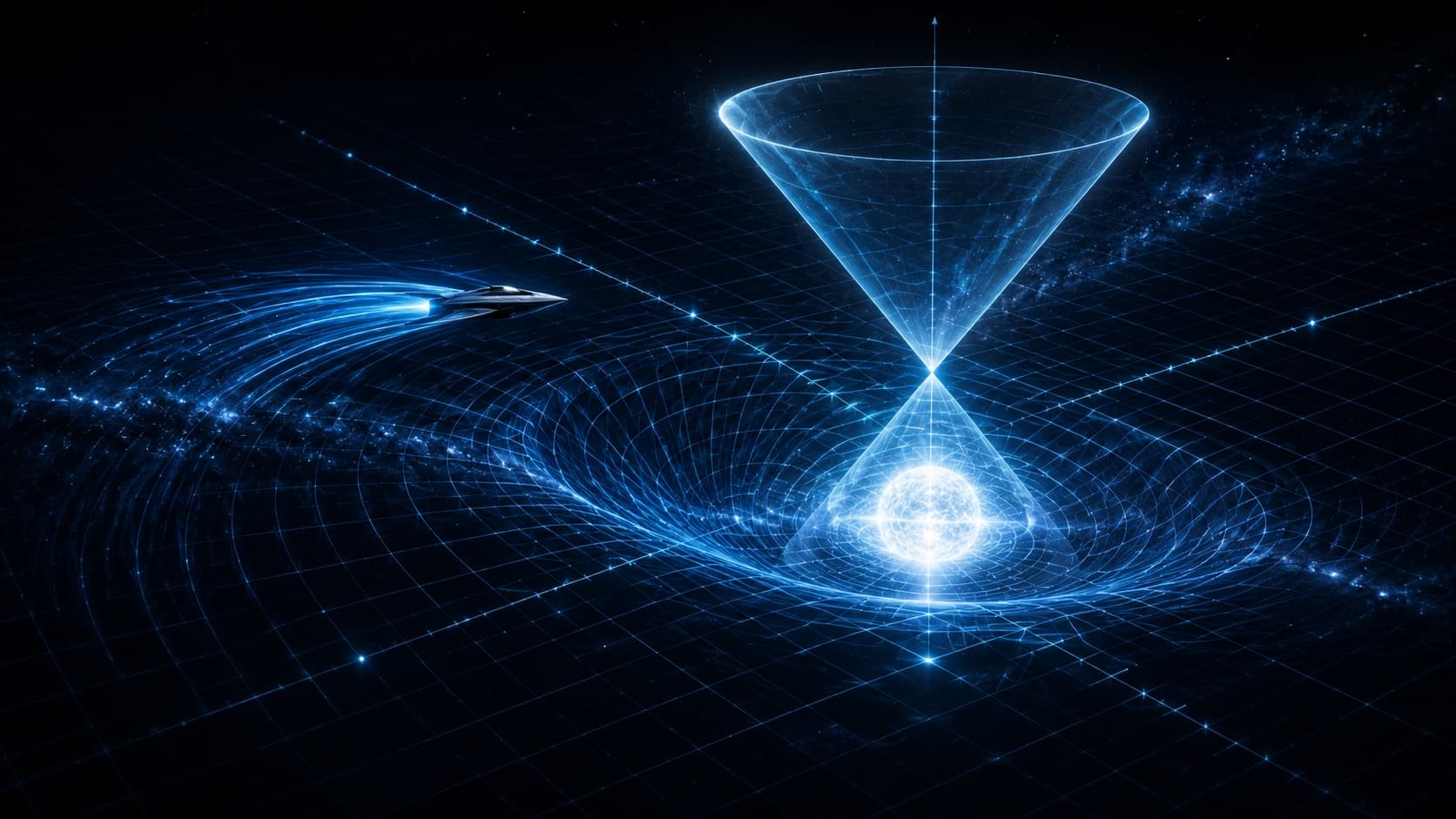
The invariant spacetime interval
PHYS 401 · Lorentz Transformations
The spacetime interval is the quantity all inertial observers agree on. This lesson introduces timelike, spacelike, and lightlike separations and explains why the interval replaces absolute space and time.
Key equations
Delta s^2=-c^2Delta t^2+Delta x^2+Delta y^2+Delta z^2Delta s^2=c^2Delta t^2-Delta x^2-Delta y^2-Delta z^2Delta s^2=-c^2Delta t^2+Delta x^2c^2Delta t^2>Delta x^2+Delta y^2+Delta z^2c^2Delta au^2=c^2Delta t^2-Delta r^2Delta r^2=Delta x^2+Delta y^2+Delta z^2Delta r^2>c^2Delta t^2Delta r^2=c^2Delta t^2Delta s^2=0Learning objectives
- Define the invariant spacetime interval.
- Explain why the interval is invariant under Lorentz transformations.
- Classify intervals as timelike, spacelike, or lightlike.
- Relate timelike intervals to proper time.
- Connect interval classification to causality.
From separate absolutes to one invariant
In classical physics, time intervals and spatial distances are separately invariant. All observers agree on , and all observers agree on lengths when measured correctly. Special relativity changes this. Different inertial observers may disagree on time separation and spatial separation between two events.
But they agree on a combined quantity: the spacetime interval.
Definition of the interval
For two events separated by , , , and , define
This sign convention is common in relativity. Some books use the opposite sign:
The physics is the same if the convention is used consistently.
Invariance
Under Lorentz transformations, and change, but stays the same. In one spatial dimension,
All inertial observers compute the same value for .
This is analogous to rotations in ordinary geometry. A rotation changes coordinate components and , but leaves unchanged. A Lorentz transformation changes space and time components but leaves the spacetime interval unchanged.
Timelike intervals
If
then the separation is timelike. A slower-than-light object or signal could travel from one event to the other. There exists a frame in which the two events occur at the same place.
For timelike intervals, proper time is defined by
where
Spacelike intervals
If
then the separation is spacelike. No signal traveling at or below can connect the events. There exists a frame in which the two events are simultaneous.
The time order of spacelike-separated events can differ between frames, but that does not violate causality because neither event can influence the other by allowed signals.
Lightlike intervals
If
then the separation is lightlike or null. Light in vacuum can connect the events. For such intervals,
All observers agree that the interval is zero, and all measure the connecting light ray moving at speed .
Physical meaning
The invariant interval is the geometric foundation of special relativity. Instead of absolute time and absolute space, relativity has absolute spacetime structure. Observers slice spacetime differently into space and time, but the interval remains unchanged.
The big idea
The spacetime interval is the invariant quantity shared by all inertial observers. It classifies event separations as timelike, spacelike, or lightlike. This classification determines possible causal relationships and replaces the classical idea that space and time are separately absolute.
Sign in to track your progress.
Ask your AI physics guide
Ask anything about Special Relativity — The invariant spacetime interval, or choose a suggested question below.
AI responses are educational and may not be perfectly accurate. Press Enter to send, Shift+Enter for new line.