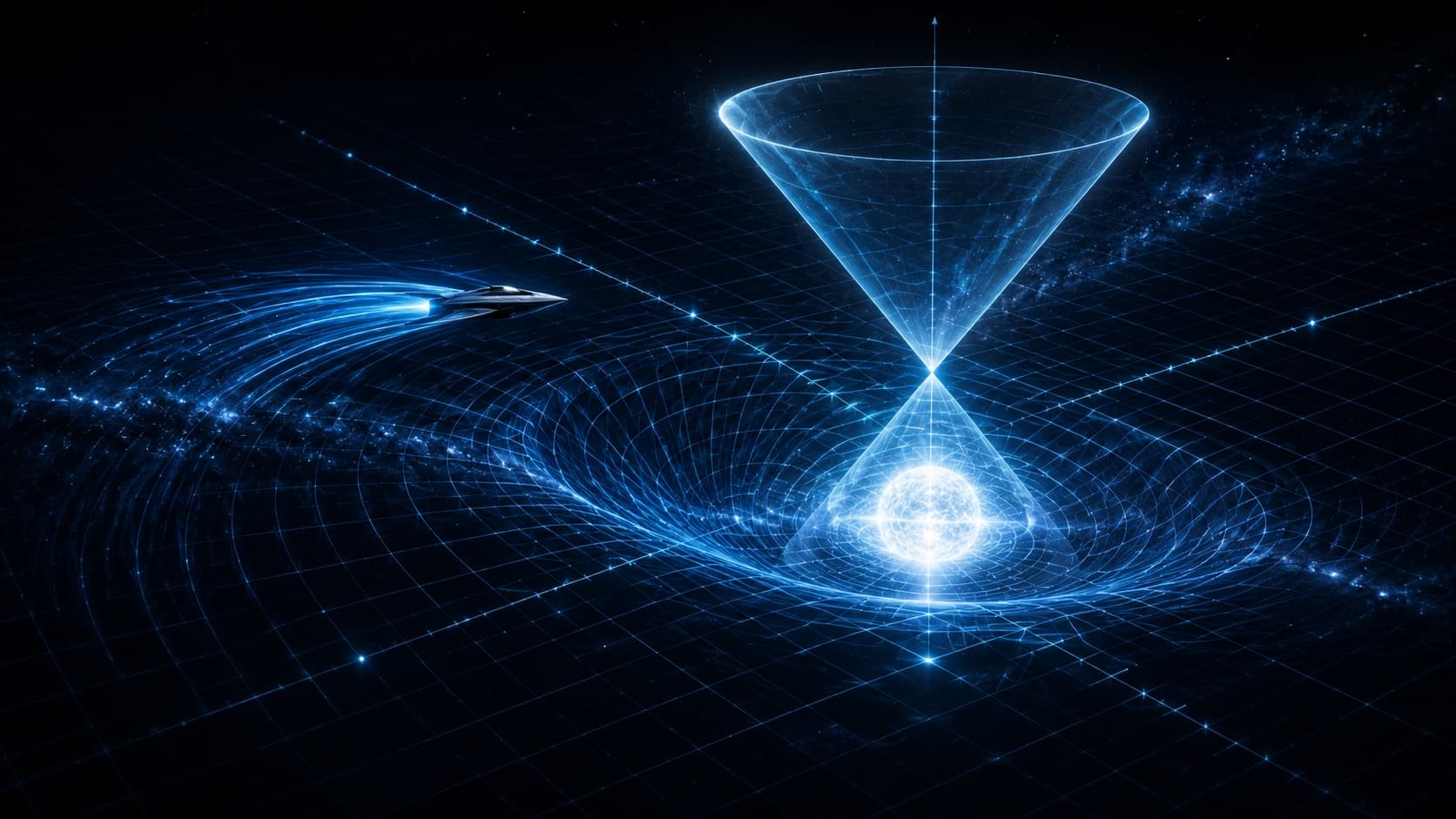
The light cone
PHYS 401 · Lorentz Transformations
The light cone separates events that can be causally connected from those that cannot. This lesson explains future, past, and elsewhere regions of spacetime.
Key equations
x=pm ctc^2t^2>x^2t>0t<0x^2>c^2t^2x^2=c^2t^2r^2=c^2t^2Learning objectives
- Define a light cone.
- Identify future, past, and elsewhere regions.
- Relate light cones to timelike, spacelike, and lightlike intervals.
- Explain why causal order is invariant for timelike events.
- Describe why spacelike time order can vary without violating causality.
Light as the boundary of causality
In special relativity, no information or material object can travel faster than light in vacuum. This makes light rays the boundary between events that can be causally connected and events that cannot.
A light cone is the set of all possible lightlike paths through an event. In a diagram with one space dimension and time, it appears as two crossing lines. With two space dimensions, it forms an actual cone.
Future light cone
Consider an event at and . Light emitted from that event satisfies
in one spatial dimension. Events inside the future light cone satisfy
with . These events can be reached by slower-than-light signals or objects from .
The future light cone contains events that can influence.
Past light cone
The past light cone contains events that could have influenced . These are timelike or lightlike events with relative to .
For example, the light reaching your eyes from a star tonight lies on your past light cone. The star as you see it is not at the star's current distant-frame time; it is an event in your causal past.
Elsewhere
Events outside the light cone are spacelike separated from . In one spatial dimension, they satisfy
No signal traveling at or below can connect them to . They are sometimes called elsewhere because they are neither in the causal past nor causal future of the event.
Different inertial observers may disagree about the time order of spacelike events, but all agree that they are spacelike.
Lightlike boundary
Events exactly on the cone satisfy
or in three spatial dimensions,
They can be connected to only by light or another massless signal traveling at .
Causal order
For timelike-separated events, all observers agree on their time order. If event A can cause event B, no Lorentz transformation can reverse that order.
For spacelike-separated events, time order is frame-dependent. But because no causal signal can connect them, this does not create causal contradiction.
Worldlines and cones
The worldline of a massive particle must stay inside its local light cone. A light ray follows the cone surface. A hypothetical faster-than-light path would go outside the cone, creating serious causality problems in special relativity.
Relativity and the present
The light cone also challenges the idea of a universal present. Different observers slice spacetime into simultaneous surfaces differently. The invariant structure is not a universal now, but the causal cone structure shared by all observers.
The big idea
The light cone organizes spacetime into causal future, causal past, and elsewhere. Timelike and lightlike events can be causally connected; spacelike events cannot. All inertial observers agree on this causal classification, even when they disagree about simultaneity or time order for spacelike events.
Sign in to track your progress.
Up next · Module 4
Relativistic Dynamics
This module updates momentum, energy, and particle dynamics for speeds near light. Students study relativistic momentum, kinetic energy, rest energy, the energy-momentum relation, and massless particles.
Ask your AI physics guide
Ask anything about Special Relativity — The light cone, or choose a suggested question below.
AI responses are educational and may not be perfectly accurate. Press Enter to send, Shift+Enter for new line.