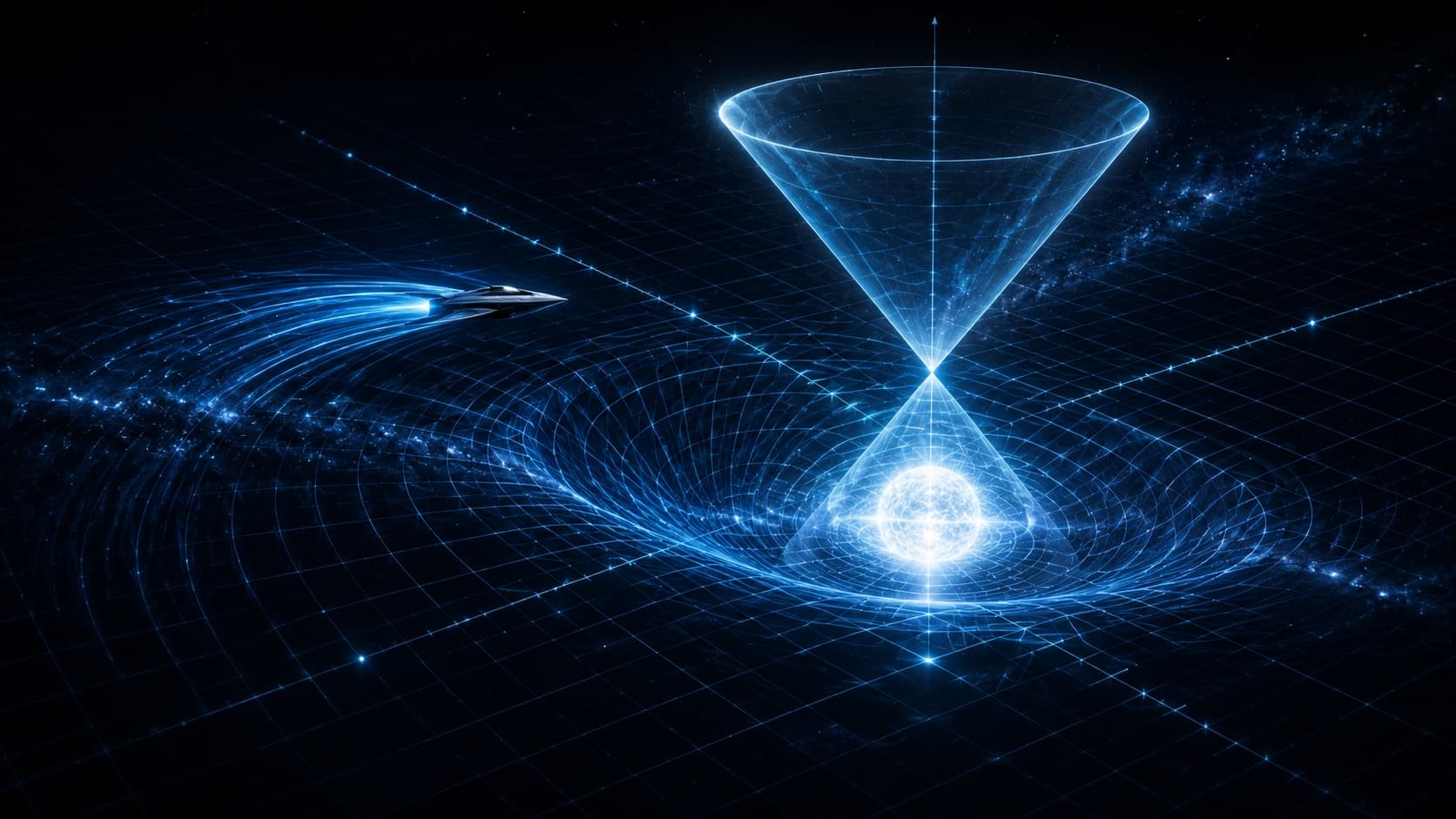
Consequences of constant light speed
PHYS 401 · The Foundations of Relativity
A constant light speed forces changes in measurements of time, length, and simultaneity. This lesson previews the major effects of special relativity through light-clock reasoning.
Key equations
Delta au=
rac{2L}{c}Delta t=gammaDelta augamma=
rac{1}{sqrt{1-v^2/c^2}}L=
rac{L_0}{gamma}vll cgammaapprox1+
rac{1}{2}
rac{v^2}{c^2}Learning objectives
- Use a light clock to explain time dilation qualitatively.
- State the time dilation and length contraction formulas.
- Explain why simultaneity becomes relative.
- Recognize light speed as a causal speed limit.
- Distinguish relativistic effects from optical illusions.
The cost of keeping constant
If all inertial observers measure the same vacuum light speed, then familiar assumptions about time and space cannot all survive. In classical physics, time is universal and lengths are absolute. In special relativity, the speed of light is universal, and time and space adjust.
The consequences include time dilation, length contraction, relativity of simultaneity, new velocity addition, and a unified spacetime geometry.
The light clock
A light clock is a thought experiment consisting of two mirrors separated by distance , with a pulse of light bouncing between them. In the clock's rest frame, one tick might be the light traveling up and back down. The time for one round trip is
Delta au= rac{2L}{c}
This is the proper time: the time measured by a clock at rest with the two events marking the tick.
Moving light clock
Now imagine the light clock moving sideways relative to an observer. That observer sees the light follow a diagonal path between mirror reflections. The light travels a longer distance, but still at speed .
Since speed is fixed and distance is longer, the moving clock's tick takes more time. This is time dilation:
where
gamma= rac{1}{sqrt{1-v^2/c^2}}
A moving clock runs slow relative to an inertial observer.
Length contraction preview
If time intervals change between observers, lengths must also change. Consider a fast particle with a short lifetime traveling through the atmosphere. In Earth's frame, the particle lives longer due to time dilation and can reach the ground. In the particle's frame, its lifetime is normal, but the atmosphere is length-contracted.
The contraction formula is
L= rac{L_0}{gamma}
where is proper length, measured in the object's rest frame.
Simultaneity changes
Constant light speed also changes simultaneity. Two events that are simultaneous in one frame may not be simultaneous in another frame moving relative to the first.
This is not an illusion caused by signal travel delay. Even after correcting for light travel time according to each observer's synchronization procedure, observers in relative motion can disagree about whether separated events occurred at the same time.
No faster-than-light information
If light speed is the same for all inertial observers, it becomes a universal speed limit for signals and causal influence. Massive objects require ever-increasing energy as they approach and cannot be accelerated to or beyond it.
This preserves causal order for events that can influence one another.
Classical limit
At everyday speeds, these effects are extremely small. If , then
gammaapprox1+ rac{1}{2} rac{v^2}{c^2}
For ordinary vehicles, is so tiny that time dilation and length contraction are undetectable without precision instruments.
Not optical illusion
Relativistic effects are not just appearances caused by finite light travel time. They are relationships between measured coordinates after observers account for signal propagation. A moving clock really records less proper time between two meetings than a stationary clock along a different path.
The big idea
The constancy of light speed forces a restructuring of time and space. Moving clocks are measured to run slow, moving lengths contract along the direction of motion, and simultaneity becomes frame-dependent. These effects are small at low speeds but fundamental at speeds near .
Sign in to track your progress.
Up next · Module 2
Time and Space
This module develops the core kinematic effects of special relativity. Students study time dilation, length contraction, relativity of simultaneity, and spacetime diagrams as tools for visualizing events.
Ask your AI physics guide
Ask anything about Special Relativity — Consequences of constant light speed, or choose a suggested question below.
AI responses are educational and may not be perfectly accurate. Press Enter to send, Shift+Enter for new line.