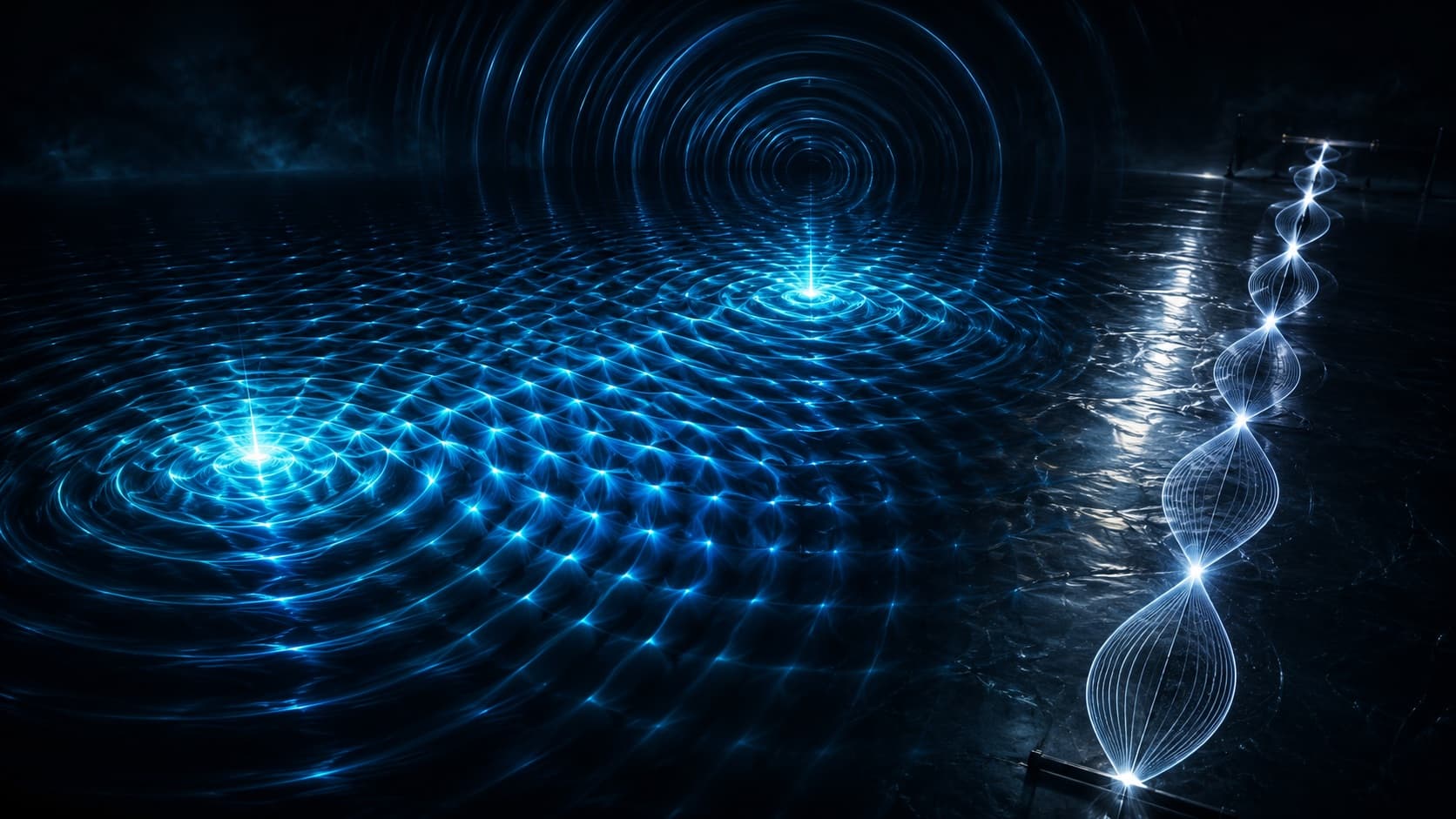
Constructive and destructive interference
PHYS 210 · Superposition and Interference
Interference occurs when overlapping waves combine to reinforce or cancel. This lesson explains phase difference, path difference, and conditions for constructive and destructive interference.
Key equations
y_1=A\cos(kx-\omega t)y_2=A\cos(kx-\omega t+\Delta\phi)A_{result}=2A\left|\cos\left(\frac{\Delta\phi}{2}\right)\right|\Delta\phi=2\pi m\Delta L=m\lambda\Delta\phi=(2m+1)\pi\Delta L=\left(m+\frac{1}{2}\right)\lambdad\sin\theta=m\lambdaLearning objectives
- Define constructive and destructive interference.
- Relate phase difference to resulting amplitude.
- Use path difference conditions for interference.
- Apply interference ideas to sound and light.
- Explain energy redistribution in interference patterns.
Interference from superposition
Interference is the pattern produced when waves overlap and add. If waves reinforce, the interference is constructive. If waves cancel, it is destructive. Interference can occur with sound, water waves, light, radio waves, matter waves, and waves on strings.
The key quantity is phase difference. Waves with the same frequency and a constant phase relationship are coherent. Coherence allows stable interference patterns.
Phase difference
Consider two waves of the same amplitude, wave number, and angular frequency:
The phase difference is . If , the waves are in phase and reinforce. If , the waves are exactly out of phase and cancel at points where their amplitudes are equal.
Using a trig identity, their sum has amplitude
ight) ight|$$ This shows how phase controls the resulting amplitude. ## Constructive interference Constructive interference occurs when waves arrive in phase. The phase difference is an integer multiple of $2pi$: $$Deltaphi=2pi m$$ where $m$ is an integer. In terms of path difference $Delta L$, constructive interference occurs when $$Delta L=mlambda$$ This means one wave travels an integer number of wavelengths farther than the other. ## Destructive interference Destructive interference occurs when waves arrive half a cycle out of phase. The phase difference is $$Deltaphi=(2m+1)pi$$ In terms of path difference, $$Delta L=left(m+ rac{1}{2} ight)lambda$$ This means the path difference is a half-integer number of wavelengths. ## Sound interference Sound waves from two speakers can interfere. At some locations, compressions from both speakers arrive together and produce louder sound. At other locations, a compression from one arrives with a rarefaction from the other, reducing sound intensity. This is why moving around in a room with steady tones can produce spots of louder and softer sound. ## Light interference Light interference is evidence of light's wave nature. In double-slit interference, light from two slits overlaps on a screen, producing bright and dark fringes. Bright fringes occur where path difference is an integer multiple of wavelength. Dark fringes occur where path difference is a half-integer multiple. For small angles in a double-slit setup, bright fringes satisfy $$dsin heta=mlambda$$ where $d$ is slit separation. ## Interference and energy Destructive interference at a point does not eliminate energy from the universe. Instead, energy is redistributed. In a stable interference pattern, dark regions are accompanied by bright regions where intensity is greater. This is especially clear in light interference: energy missing from dark fringes appears in bright fringes. ## The big idea Constructive and destructive interference are direct consequences of superposition and phase. Waves reinforce when they arrive in phase and cancel when they arrive out of phase. Path difference connects geometry to interference, making it possible to predict sound patterns, light fringes, and wave behavior across physics.Sign in to track your progress.
Ask your AI physics guide
Ask anything about Waves and Oscillations — Constructive and destructive interference, or choose a suggested question below.
AI responses are educational and may not be perfectly accurate. Press Enter to send, Shift+Enter for new line.