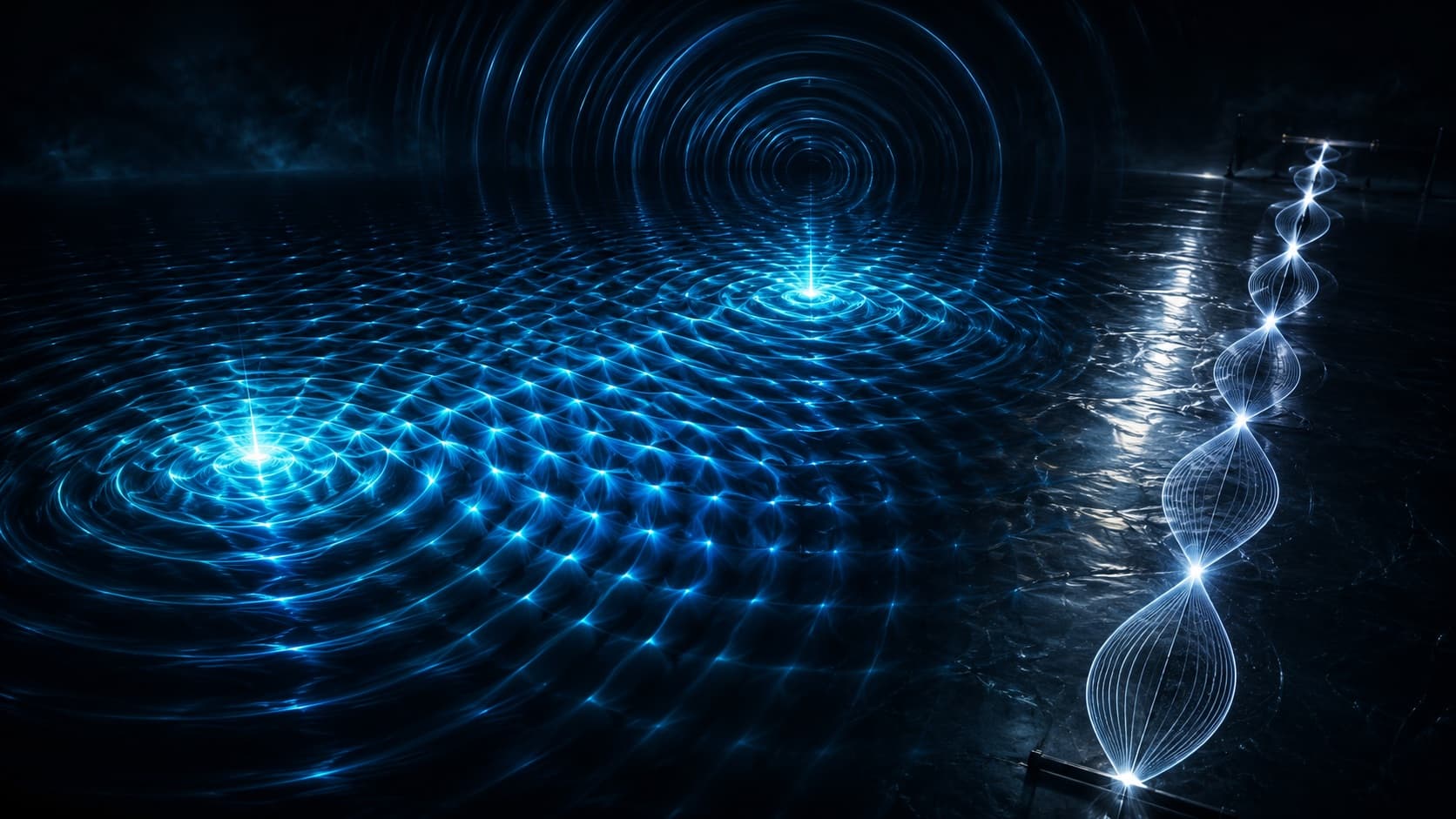
The superposition principle
PHYS 210 · Superposition and Interference
The superposition principle says overlapping waves add. This lesson introduces linearity, wave addition, pulses, and why superposition underlies interference.
Key equations
y(x,t)=y_1(x,t)+y_2(x,t)\frac{\partial^2 y}{\partial x^2}=\frac{1}{v^2}\frac{\partial^2 y}{\partial t^2}y_1+y_2y_1=A\cos(kx-\omega t)y_2=A\cos(kx-\omega t)y=2A\cos(kx-\omega t)y_2=-A\cos(kx-\omega t)y=0y_{total}=\sum_i y_iLearning objectives
- State the superposition principle for linear waves.
- Explain how overlapping wave displacements add.
- Connect superposition to linearity of the wave equation.
- Describe pulse interactions in an ideal medium.
- Recognize limits of superposition in nonlinear systems.
Adding waves
The superposition principle says that when two or more waves overlap in a linear medium, the total displacement is the sum of the individual displacements. If two waves are described by and , the total wave is
This simple rule produces many important wave phenomena: interference, standing waves, beats, diffraction patterns, and Fourier synthesis.
Linearity
Superposition works exactly for systems governed by linear equations. The wave equation
rac{partial^2 y}{partial x^2}= rac{1}{v^2} rac{partial^2 y}{partial t^2}
is linear because if and are solutions, then
is also a solution.
Linearity means the medium's response to combined disturbances is the sum of its responses to each disturbance separately.
Pulses passing through each other
Imagine two pulses traveling toward each other on a string. When they overlap, their displacements add. If both pulses are upward, the string displacement becomes larger during overlap. If one is upward and the other downward, they can partially or completely cancel.
After passing through each other, the pulses continue moving as if nothing happened, assuming the medium is linear and ideal. This is different from colliding objects, which often exchange momentum and energy in more direct ways.
Constructive and destructive addition
If overlapping waves have the same sign displacement at a point, they reinforce. If they have opposite signs, they cancel partly or fully. These are not separate laws; they are consequences of adding wave displacements.
For two identical waves in phase,
the result is
The amplitude doubles.
For two identical waves exactly out of phase,
the result is
at all points and times in the ideal case.
Superposition of many waves
The principle is not limited to two waves. Many waves can overlap, and the total disturbance is the sum of all contributions:
This is how complex sounds, water patterns, electromagnetic signals, and quantum wavefunctions are analyzed.
Energy and superposition
Displacements add directly, but energy does not simply add in the same way because energy often depends on amplitude squared. When waves interfere constructively in one region and destructively in another, energy is redistributed. Destructive interference at one location does not mean energy has been destroyed.
In an interference pattern, dark regions and bright regions represent redistribution of energy flow.
Limits of superposition
Superposition is exact only for linear systems. At very large amplitudes, many media become nonlinear. Waves may distort, interact, or change speed depending on amplitude. Shock waves, breaking water waves, and some intense sound waves involve nonlinear effects.
Still, superposition is an excellent approximation for many waves in strings, sound, light, and small oscillations.
The big idea
Superposition means overlapping waves add. It follows from linearity and provides the foundation for interference, standing waves, beats, and Fourier analysis. Although energy behavior can be subtle, wave displacement addition is the central rule for understanding combined wave motion.
Sign in to track your progress.
Ask your AI physics guide
Ask anything about Waves and Oscillations — The superposition principle, or choose a suggested question below.
AI responses are educational and may not be perfectly accurate. Press Enter to send, Shift+Enter for new line.