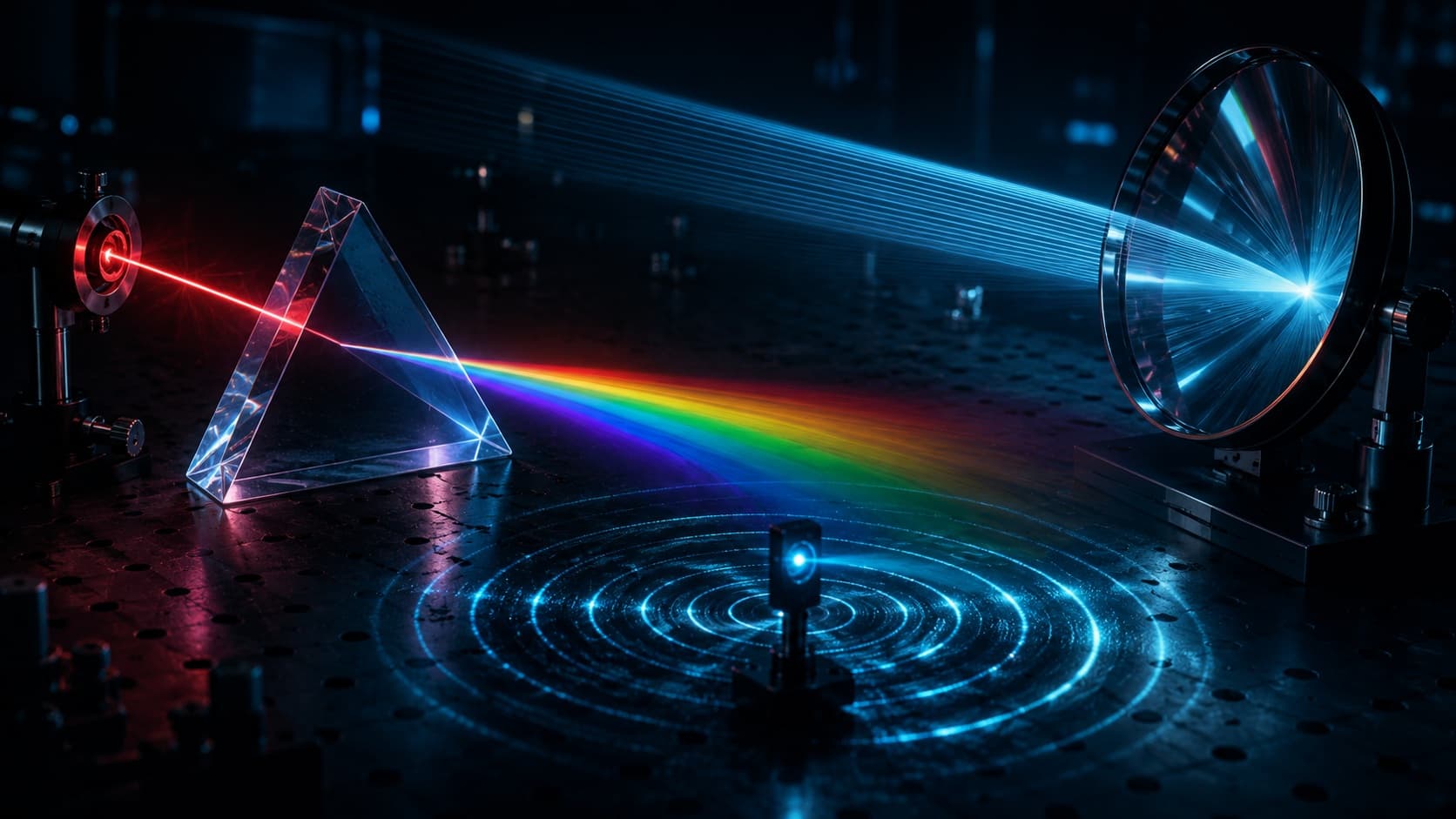
Diffraction gratings
PHYS 310 · Wave Optics
A diffraction grating uses many closely spaced slits to produce sharp interference maxima. This lesson explains grating equations, spectral separation, resolving power, and applications.
Key equations
d\sin\theta=m\lambdam=0,\pm1,\pm2,\ldots\sin\theta=\frac{m\lambda}{d}|m\lambda|\leq dd=\frac{1}{N_L}d\cos\theta\frac{d\theta}{d\lambda}=m\frac{d\theta}{d\lambda}=\frac{m}{d\cos\theta}R=\frac{\lambda}{\Delta\lambda}=mNLearning objectives
- Explain how a diffraction grating differs from a double slit.
- Apply the grating equation.
- Determine possible diffraction orders.
- Calculate angular dispersion conceptually and mathematically.
- Use resolving power to compare gratings.
Many-slit interference
A diffraction grating consists of many equally spaced slits or grooves. It creates interference patterns with very sharp bright maxima. Compared with a double slit, a grating produces narrower, more intense principal maxima and better wavelength separation.
Gratings are essential tools in spectroscopy, where they separate light into its component wavelengths.
Grating equation
Let be the spacing between adjacent slits. Constructive interference occurs when light from neighboring slits has path difference equal to an integer number of wavelengths:
where is the order number:
This is the same condition as double-slit bright fringes, but many slits make the maxima much sharper.
Orders
The central maximum corresponds to and occurs at for all wavelengths. Higher orders spread wavelengths by angle. For a given order, longer wavelengths appear at larger angles because
sin heta= rac{mlambda}{d}
Only orders satisfying
can exist because .
Line density
Gratings are often specified by lines per unit length. If a grating has lines per meter, the slit spacing is
d= rac{1}{N_L}
A larger line density means smaller , which increases angular separation between wavelengths but may reduce the number of observable orders.
Angular dispersion
Angular dispersion measures how rapidly angle changes with wavelength. Differentiate the grating equation:
dcos heta rac{d heta}{dlambda}=m
so
rac{d heta}{dlambda}= rac{m}{dcos heta}
Higher order and smaller slit spacing give greater dispersion, meaning better wavelength separation.
Resolving power
Resolving power describes the ability to distinguish two nearby wavelengths. For a grating with illuminated slits in order ,
R= rac{lambda}{Deltalambda}=mN
A grating resolves closer wavelengths when more slits are illuminated and when higher diffraction order is used.
Transmission and reflection gratings
A transmission grating lets light pass through slits. A reflection grating uses grooves on a reflective surface. Many practical spectrometers use reflection gratings because they can be efficient and durable.
Groove shape can be designed to direct more light into a desired order. This is called blazing.
Applications
Diffraction gratings are used in spectrometers, astronomy, chemistry, lasers, optical communications, and wavelength measurement. By measuring diffraction angles, one can determine unknown wavelengths or identify chemical elements from emission and absorption spectra.
The big idea
A diffraction grating uses many coherent sources to create sharp interference maxima. The grating equation determines angular positions, while dispersion and resolving power determine how well wavelengths can be separated. Gratings turn interference into a precise measurement tool.
Sign in to track your progress.
Ask your AI physics guide
Ask anything about Optics and Light — Diffraction gratings, or choose a suggested question below.
AI responses are educational and may not be perfectly accurate. Press Enter to send, Shift+Enter for new line.