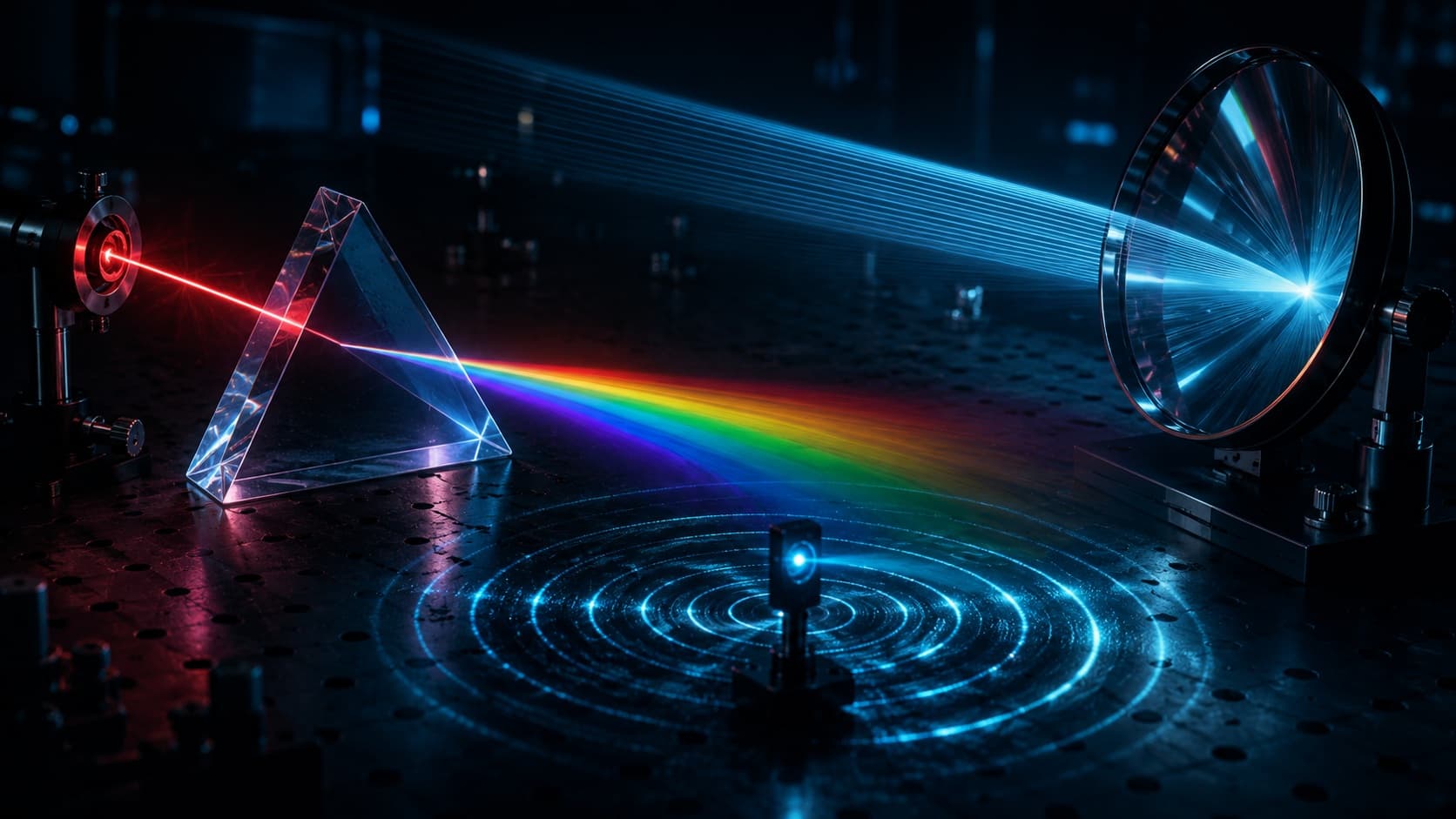
Huygens' principle
PHYS 310 · Wave Optics
Huygens' principle models every point on a wavefront as a source of secondary wavelets. This lesson uses it to explain reflection, refraction, and diffraction conceptually.
Key equations
\theta_i=\theta_rn_1\sin\theta_1=n_2\sin\theta_2n=\frac{c}{v}Learning objectives
- Define wavefronts and relate them to rays.
- State Huygens' principle.
- Use Huygens' principle to explain reflection and refraction.
- Explain diffraction qualitatively.
- Describe the role of interference in the Huygens-Fresnel principle.
Wavefronts instead of rays
In wave optics, light is described by wavefronts as well as rays. A wavefront is a surface of constant phase. For example, crests of a water wave form wavefronts. In three dimensions, a point source produces spherical wavefronts, while a distant source produces nearly plane wavefronts.
Rays point perpendicular to wavefronts and show the direction of energy propagation in simple media.
Huygens' principle
Huygens' principle states that every point on a wavefront acts as a source of secondary spherical wavelets. The new wavefront at a later time is the envelope tangent to these wavelets.
This principle gives a geometric way to construct wave propagation. It also helps explain reflection, refraction, and diffraction.
Straight-line propagation
In a uniform medium, a plane wavefront advances uniformly because all secondary wavelets expand at the same speed. The envelope remains a plane. This corresponds to rays traveling in straight lines.
Thus ray optics appears as a limiting case of wave optics when wavelength is small compared with the scale of objects.
Reflection from Huygens' principle
When a wavefront reaches a reflecting surface, points on the surface act as sources of reflected wavelets. Constructing the reflected wavefront leads to the law of reflection:
The equality of angles follows from the equal speed of incident and reflected waves in the same medium.
Refraction from Huygens' principle
When a wavefront enters a slower medium at an angle, one part of the wavefront slows before the rest. The wavefront pivots, changing ray direction. Huygens' construction gives Snell's law:
Since refractive index is related to speed by
n= rac{c}{v}
the bending reflects a change in wave speed.
Diffraction
Huygens' principle naturally explains diffraction: waves spread when they pass through openings or around obstacles. If an aperture is much larger than the wavelength, spreading is small and rays seem to travel straight. If the aperture is comparable to wavelength, spreading is strong.
This is why sound diffracts around doorways more obviously than visible light. Sound wavelengths are much larger than visible light wavelengths.
Huygens-Fresnel principle
A more complete version, called the Huygens-Fresnel principle, includes interference among the secondary wavelets. The amplitude at a point is found by summing contributions from many wavelets with phase differences.
This interference is essential for calculating diffraction patterns quantitatively.
Limitations and modern view
Huygens' principle is a powerful construction, but modern electromagnetic theory provides the deeper foundation. Maxwell's equations describe how electric and magnetic fields propagate and satisfy wave equations. Huygens' principle remains useful because it gives intuitive geometric insight.
The big idea
Huygens' principle treats every point on a wavefront as a source of secondary wavelets. It explains straight-line propagation, reflection, refraction, and diffraction as wavefront behavior. It bridges geometric optics and wave optics and prepares the way for interference and diffraction patterns.
Sign in to track your progress.
Ask your AI physics guide
Ask anything about Optics and Light — Huygens' principle, or choose a suggested question below.
AI responses are educational and may not be perfectly accurate. Press Enter to send, Shift+Enter for new line.