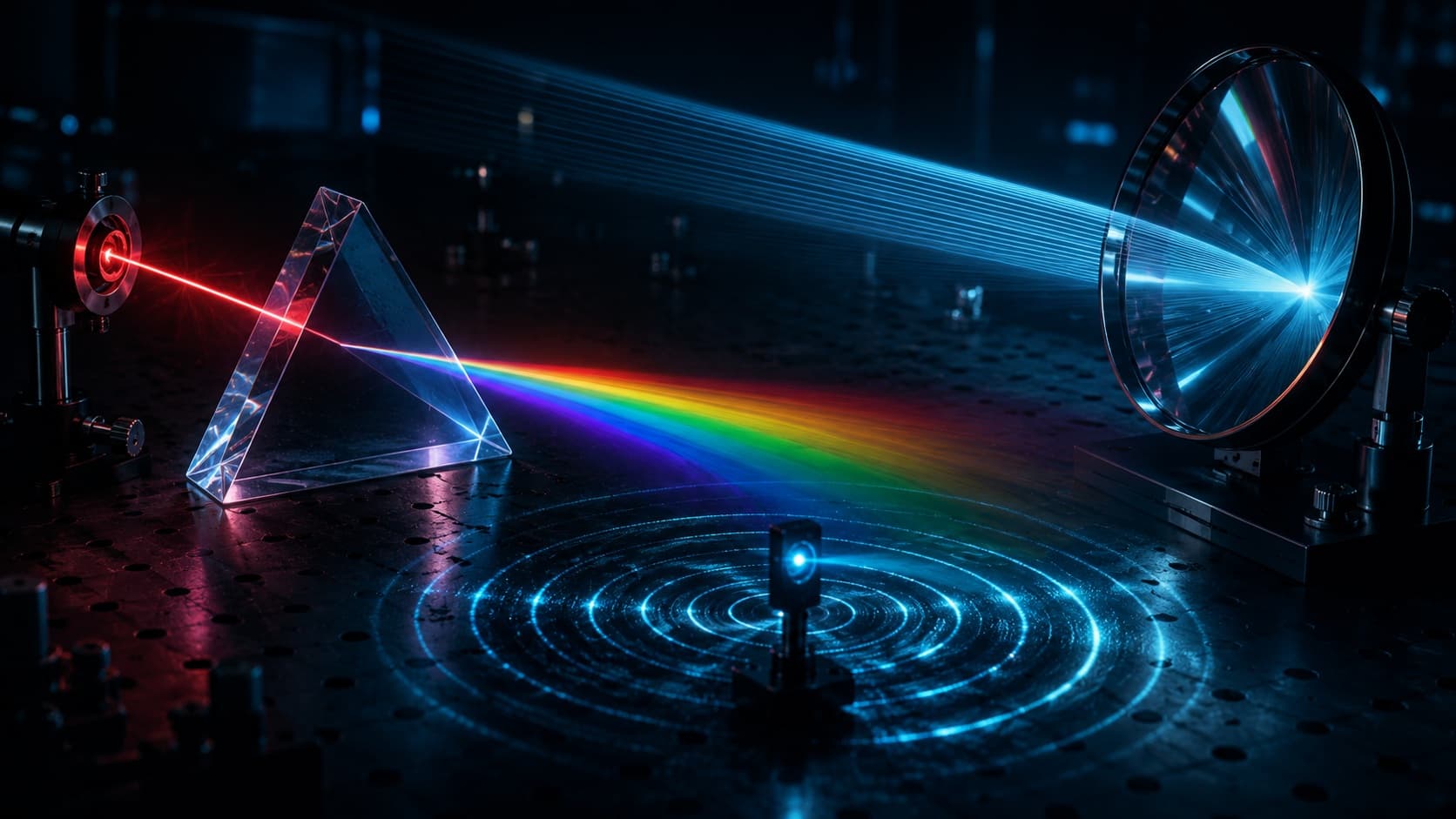
Young's double-slit experiment
PHYS 310 · Wave Optics
Young's double-slit experiment demonstrates interference of light. This lesson derives fringe conditions, fringe spacing, and the wave interpretation of bright and dark bands.
Key equations
\Delta L=d\sin\thetad\sin\theta=m\lambdam=0,\pm1,\pm2,\ldotsd\sin\theta=\left(m+\frac{1}{2}\right)\lambda\sin\theta\approx \tan\theta\approx \frac{y}{L}y_m=\frac{m\lambda L}{d}\Delta y=\frac{\lambda L}{d}\Delta\phi=\frac{2\pi}{\lambda}\Delta L\Delta\phi=2\pi m\Delta\phi=(2m+1)\piLearning objectives
- Explain the double-slit interference pattern.
- Derive bright and dark fringe conditions.
- Use the small-angle approximation to find fringe spacing.
- Relate path difference to phase difference.
- Explain the need for coherence.
Evidence that light is a wave
Young's double-slit experiment is one of the classic demonstrations of light's wave nature. Light passes through two narrow slits and forms a pattern of bright and dark fringes on a screen. This pattern cannot be explained by simple ray optics alone.
The bright and dark bands are caused by interference. Light from the two slits arrives at each screen point with a path difference, producing constructive or destructive interference.
Path difference
Let the slit separation be , the observation angle be , and the wavelength be . For a distant screen, the path difference between light from the two slits is approximately
Constructive interference occurs when the path difference is an integer number of wavelengths:
where
These positions form bright fringes.
Dark fringes
Destructive interference occurs when the path difference is a half-integer number of wavelengths:
ight)lambda$$ where $m$ is an integer. At these locations, the waves arrive out of phase and cancel, producing dark fringes. ## Small-angle fringe spacing If the screen is distance $L$ from the slits and $Lgg d$, then for small angles, $$sin hetaapprox an hetaapprox rac{y}{L}$$ where $y$ is the vertical position on the screen relative to the central maximum. Bright fringe positions are approximately $$y_m= rac{mlambda L}{d}$$ The spacing between adjacent bright fringes is $$Delta y= rac{lambda L}{d}$$ This formula shows that larger wavelength or larger screen distance increases fringe spacing, while larger slit separation decreases it. ## Phase difference Path difference corresponds to phase difference: $$Deltaphi= rac{2pi}{lambda}Delta L$$ Constructive interference occurs when $$Deltaphi=2pi m$$ Destructive interference occurs when $$Deltaphi=(2m+1)pi$$ This phase view generalizes to many interference problems. ## Coherence A stable interference pattern requires coherence. The two slit sources must maintain a stable phase relationship. In Young's experiment, the two slits are illuminated by the same source, so they act as coherent secondary sources. If the phase relationship changes randomly too quickly, the interference pattern washes out. ## Double-slit with single photons Modern experiments can send light through a double slit one photon at a time. Individual photons are detected as localized events, but after many photons, the interference pattern builds up. This reveals the quantum nature of light: probability amplitudes interfere. At this course level, the classical wave model explains the fringe locations, while quantum optics gives a deeper interpretation. ## The big idea Young's double-slit experiment shows that light interferes like a wave. Bright fringes occur where path difference is $mlambda$; dark fringes occur where path difference is $(m+1/2)lambda$. The experiment connects wavelength, geometry, phase, coherence, and the wave nature of light.Sign in to track your progress.
Ask your AI physics guide
Ask anything about Optics and Light — Young's double-slit experiment, or choose a suggested question below.
AI responses are educational and may not be perfectly accurate. Press Enter to send, Shift+Enter for new line.